
TRAVEL GUIDE / BIKE LOGISTICS
TRAVEL GUIDE / UPDATED 21 SEPTEMBER 2026
Getting to Cozumel with a bike.
Choose the right airport, leave enough time between connections and arrive early enough to inspect, build and test your bike before race day.
- Island airport
- CZM / direct route
- Mainland airport
- CUN / road + ferry
- Passenger ferry
- Playa del Carmen
- Recheck transport rules
- 7 days before travel
QUICK DECISION
Choose how you will reach the island.
Cozumel has its own international airport. Flying to Cancún may give you more flight options, but you must then travel to Playa del Carmen and take a passenger ferry with your bike case.
- 01
Choose CZM if the schedule and total cost work for you. It is the simplest route because you land on Cozumel.
- 02
Choose CUN if it offers a much better flight and you have enough time to take an ADO bus or reserved van to Playa del Carmen, then board the ferry.
- 03
Compare the total cost: airfare, bicycle fee, ground transport, ferry tickets and a possible overnight stay in Playa.
ARRIVAL ROUTES
Two ways to reach Cozumel.
A direct flight to CZM requires one local transfer. A flight to CUN requires ground transport to Playa del Carmen, a ferry and another transfer on Cozumel.
ROUTE A / CZM
Fly directly to Cozumel.
Land on Cozumel, collect your bike and take one suitable vehicle to your accommodation. You do not need a mainland transfer or ferry.
- 01Flight
- 02CZM
- 03Local transfer
- 04Accommodation
- Works best for
- First visits, hard cases, solo athletes and anyone who wants the fewest transfers.
- Tradeoff
- There are fewer flights, some routes are seasonal and the fare may be higher than flying to Cancún.
ROUTE B / CUN
Fly to Cancún and cross from Playa.
Collect your bike at CUN and take the ADO airport bus to Playa del Carmen. The luggage bays usually have plenty of room for bike cases. A large group or anyone on a tight schedule may prefer a reserved van. From Playa, take the passenger ferry to Cozumel.
- 01Flight
- 02CUN
- 03ADO bus / reserved van
- 04Playa ferry
- 05Cozumel
- Works best for
- Travellers who want more flight options and have enough time for the bus or van and the ferry.
- Tradeoff
- ADO does not reserve space for a bike case. If one bus is full, wait for the next one. The ferry is a separate connection.
BEFORE YOU BUY THE FLIGHT
Compare the total cost of traveling with your bike.
Search for flights to both CZM and CUN. Check the sports-equipment rules for the airline operating each flight, not only the airline that sold the ticket. The operating airline decides what it will accept at check-in.
Bicycle rules vary by airline, aircraft, fare and route. Measure and weigh the packed case before you book. If the airline requires advance notice or a bicycle reservation, complete it and save the confirmation.
- 01
Measure the outside of the case, including wheels and handles.
- 02
Weigh the case with the tools, shoes and spares you intend to check.
- 03
Check fees, maximum dimensions, maximum weight and advance-notice requirements.
- 04
Check every operating airline when the ticket contains a connection or codeshare.
- 05
Keep a screenshot of the rule and the bicycle confirmation for travel day.
A cheaper flight to CUN may cost more overall after the bicycle fee, ground transport, ferry tickets and a night in Playa.
DIRECT ARRIVAL / CZM
Flying to CZM avoids the mainland transfer and ferry.
Cozumel International Airport uses the code CZM. When you land at CZM, you only need transport from the airport to your accommodation. This is usually easier with a heavy hard case or after a long flight.
Tell the transfer provider that you have a bike case and provide its dimensions. A standard car may not have room for the case, the passenger and the other luggage.
- 01
Inspect the case before leaving baggage claim and photograph any damage.
- 02
Report damage or missing luggage to the airline before leaving the airport.
- 03
Confirm the transfer vehicle by case size, not by passenger count alone.
- 04
Go to the accommodation first. Do not unpack or build at the airport.
We recommend CZM when the flight schedule and total cost work for you.
CUN / ROAD TO PLAYA
From CUN, take ADO or reserve a van to Playa.
ADO runs buses from Cancún Airport to Playa del Carmen. Its policy allows a properly packed bicycle in the luggage bay when space is available. Regular luggage has priority, so ADO does not guarantee bike space on a specific bus.
In our local experience, ADO buses usually have plenty of room for bike cases, including hard cases. If one bus is full, wait for the next departure. Reserve a van instead if several athletes are traveling together or your ferry connection is tight.
- 01
Collect and inspect the case before leaving the airport terminal.
- 02
If using ADO, arrive early and speak to staff before boarding.
- 03
Do not assume a bus ticket reserves luggage-bay space for the bicycle.
- 04
If traveling as a group, reserve a vehicle with room for every passenger, bike case and suitcase.
- 05
Build enough time into the plan to take the next ADO departure if the luggage bay is full.
Your flight, ground transport and ferry are separate bookings. If one is delayed, the next operator will not wait for you.
PLAYA / PASSENGER FERRY
Check the ferry schedule before you travel.
Passenger ferries run from Playa del Carmen to the San Miguel terminal in central Cozumel. Schedules and fares can change. Weather or the port authority may also delay or cancel a sailing. Check the ferry operator on the day you travel.
Ultramar currently allows bicycles at no additional cost in the cargo area or an available rack. Its luggage limits are separate. A packed bike case may be handled as luggage rather than as an assembled bicycle, so confirm your case size and weight with the operator.
- 01
Check Ultramar and Winjet for the travel date; do not use an old timetable screenshot.
- 02
Confirm the case dimensions, weight and any excess-luggage charge with the chosen operator.
- 03
Arrive at the Playa ferry terminal at least 40 minutes before departure; Ultramar currently requests this for passengers traveling to Cozumel.
- 04
Keep passports, electronics, medication and small valuables with you.
- 05
On arrival, use a vehicle that can take the closed case to the accommodation.
If your flight is scheduled to land at CUN less than four hours before the last ferry, stay in Playa and cross to Cozumel the next morning.
CASE / PROTECTION
Choose a case that works for the whole journey.
Choose a case that protects the bike, stays within the airline’s weight limit and fits in your ground transport. How it looks online does not matter.
01
Hard case
The strongest outer protection and the same packing layout each time.
Heaviest option; hardest to fit in small vehicles and easiest to push over baggage limits.
02
Padded soft case
Lower weight and easier storage at the accommodation.
Needs firm internal support and extra protection around the brake rotors, drivetrain, handlebars and extensions.
03
Cardboard bike box
Low cost and familiar to airline staff.
Poor in rain and repeated handling; a return box and packing materials must be secured.
PACKING CHECKLIST
- 01
Photograph the complete bike and record the frame serial number.
- 02
Mark the saddle, handlebar and extension positions before loosening anything.
- 03
Protect the derailleur, brake rotors, axle openings and exposed frame surfaces.
- 04
Place removed hardware in labeled bags secured inside the case.
- 05
Prevent wheels, tools and components from moving when the case is lifted or turned.
- 06
Put your name, mobile number, accommodation and itinerary inside and outside the case.
- 07
Carry your helmet, shoes, race kit, bike computer and essential medication in your carry-on bag.
- 08
Take photographs of the finished interior before closing the case.
AIRLINE SAFETY RULES
Do not pack filled CO₂ cartridges.
Security and airline rules for filled CO₂ cartridges vary. The FAA states that filled compressed-gas cylinders and cartridges are prohibited except for limited approved uses. Leave the cartridges at home and buy compatible replacements on Cozumel.
Carry power banks and spare lithium batteries in your carry-on bag with the terminals protected. Ask the airline about electronic shifting and e-bike batteries before booking. A typical e-bike battery cannot travel as ordinary passenger baggage.
- 01
Buy CO₂ cartridges locally rather than risking removal at screening.
- 02
Carry power banks and spare lithium batteries in your carry-on bag, protected from short circuits.
- 03
Pack tools and sharp objects in checked baggage.
- 04
Ask the operating airline about electronic-shifting and e-bike batteries.
- 05
Never travel with a damaged, swollen or recalled battery.
ARRIVAL / BUILD / CHECK
Build and test the bike before race day.
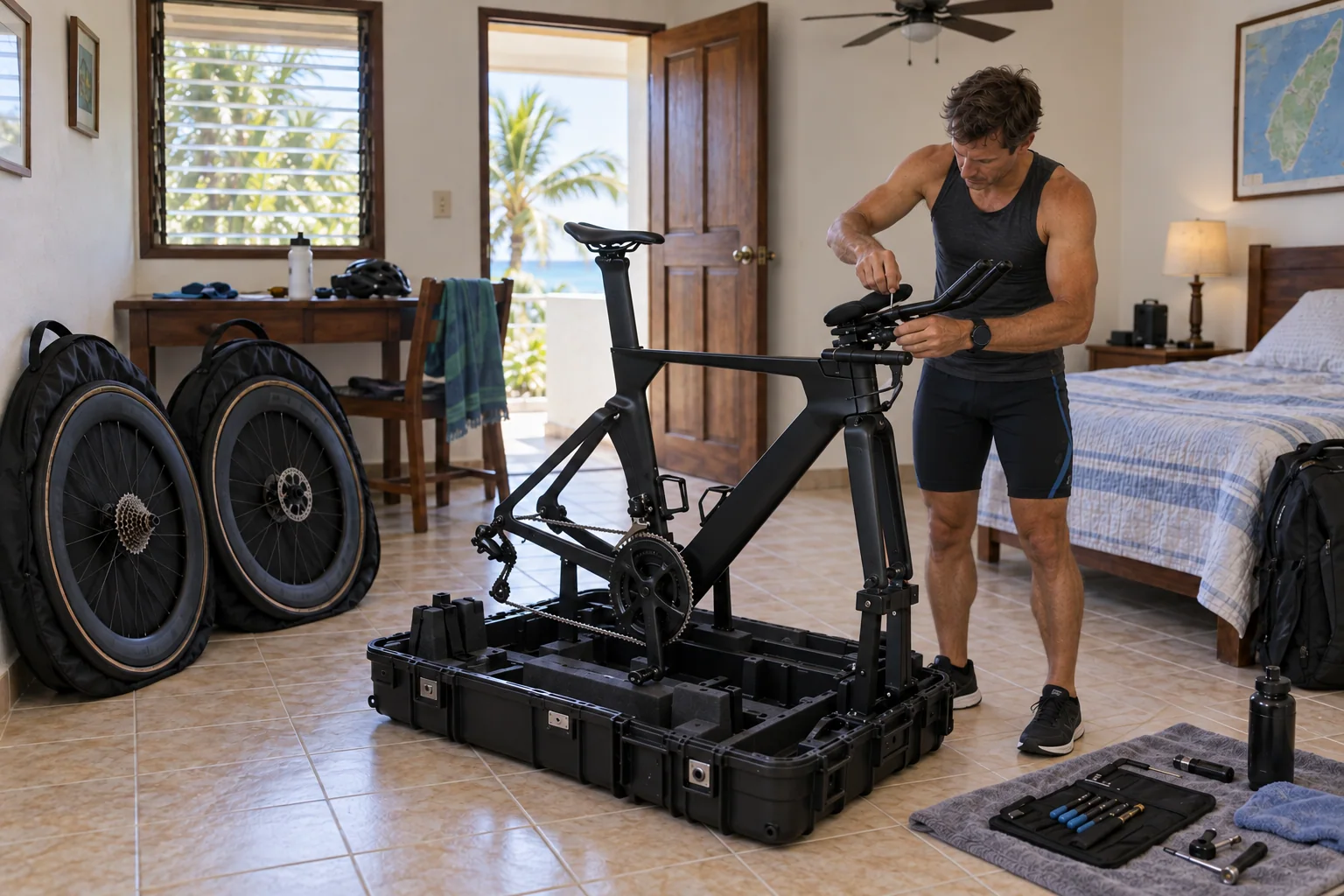
Keep the case closed until you reach your accommodation. Lay out and count every part, then assemble the bike using the manufacturer’s torque settings. Check the derailleur hanger, axles, brakes, handlebars, extensions, saddle position and tires.
Do a short activation ride in daylight. Test the brakes, gears and riding position. Stay close to town and leave enough time for a mechanic to fix anything damaged or moved in transit.
- 01
Photograph the unopened case and the bike as it comes out.
- 02
Use the position marks and hardware labels made before departure.
- 03
Torque every disturbed fastener; do not rely on feel.
- 04
Test both brakes and every gear. Make sure the wheels are secure and inspect the tires.
- 05
Confirm where the empty case will be stored for the whole stay.
For an important race, leave one full day between your activation ride and bike check-in.
THE RETURN JOURNEY
Leave extra time for the journey home.
Clean salt, sand and drink residue from the bike. Let it dry and start packing before your final evening. Check the airline’s bicycle rules again because different staff may handle the return flight.
If you fly home from CUN, your airline ticket does not cover a ferry delay. For an early or important flight, cross to Playa the day before. One night in Playa usually costs less than missing an international flight.
- 01
Photograph the bike and case again before closing it.
- 02
Count the same tools and small parts used on arrival.
- 03
Weigh the case again after adding purchases or wet race equipment.
- 04
Allow for ferry weather, road traffic and airport oversize-bag queues.
FINAL WEEK
Recheck the trip during the final week.
Schedules and baggage rules can change. Check each operator again before travel.
Check the airline bicycle policy again and confirm any reservation or advance notice.
Confirm the road-transfer vehicle, passenger count and case dimensions.
Check the current ferry schedule, weather and time available between connections.
Weigh the case, remove restricted items and save confirmations offline.
Inspect the case before leaving baggage claim. Report damage or delay immediately.
PRACTICAL ANSWERS
Questions athletes ask before booking.
These answers explain what normally happens. The airline, bus or ferry operator makes the final decision on the day.
01Is CZM or CUN better with a bike?
CZM is easier because you do not need the road transfer to Playa or the ferry. Choose CUN only when the flight, ground transport, ferry timing and total cost all work for you.
02Can I take a packed bicycle on an ADO bus?
Yes. ADO allows a properly packed bicycle in the luggage bay when space is available. The buses normally have plenty of room for bike cases. If one bus is full, wait for the next one. Arrive early and allow time for that possibility.
03Can I take a bike case on the Playa–Cozumel ferry?
Ultramar currently allows assembled bicycles without an extra bicycle fee when space is available. A packed bike case may count as luggage instead, so confirm its size and weight with the ferry operator before travel.
04How much connection time should I leave after landing at CUN?
There is no guaranteed connection time. Immigration, bike-case collection, road traffic and ferry conditions can all cause delays. Stay overnight in Playa if your flight is scheduled to land less than four hours before the last ferry.
05Should I assemble the bicycle at the airport or ferry terminal?
No. Keep the case closed through every transfer and move it directly to the accommodation. Assembly is safer with space, light, tools and a place to account for every part.
06Should CO₂ cartridges go in the bike case?
No. Filled cartridges may be removed during screening and may not meet the airline’s rules. Buy compatible cartridges after reaching Cozumel.
07What should stay in my carry-on bag?
Carry documents, medication, power banks, protected spare lithium batteries, helmet, shoes, race kit and small electronics. Follow the airline’s carry-on limits.
08Where will the empty bike case go?
Ask the accommodation before booking. A hard case can occupy much of a small room, and not every property has secure storage away from heat, rain or shared corridors.
PRIMARY SOURCES
Official sources used for this guide.
These links go to the operators and aviation authorities used for this guide. Check them again before travel because schedules, prices and baggage rules can change.
- 01ASUR / Cozumel International Airport information
- 02ADO / official guide to traveling with a bicycle
- 03ADO / permitted items and bicycle conditions
- 04Ultramar / Playa del Carmen–Cozumel service
- 05Ultramar / luggage and bicycle conditions
- 06Winjet / current schedules and fares
- 07FAA PackSafe / compressed-gas cartridges
- 08IATA / passenger guidance for lithium batteries
LOCAL SUPPORT / COZUMEL
Send us your itinerary and bike-case details.
Send your airports, arrival time, accommodation, race date and the number and size of your bike cases. We can help you plan the local transport and ferry connections.